The 2026 OECD Shift: Stubb’s Plan for Ukraine, Trade, and Global Stability
リアクション
2026年06月03日
Global economy at a crossroads: Alexander Stubb tells OECD 2026 to defend open trade, engage the Global South, and back Ukraine.
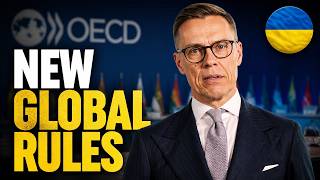
Finnish President Alexander Stubb opened the 2026 OECD Ministerial Council Meeting in Paris with a sharp message on global economic leadership. Finland chairs this year’s meeting under the theme “Getting Industrial Policies Right for Open Markets, Growth and Prosperity,” with Korea and New Zealand serving as Vice-Chairs. At a time of geopolitical uncertainty, industrial-policy competition, economic-security concerns, and rising trade restrictions, Stubb presented the OECD as a trusted platform for evidence-based cooperation and rules-based global governance.
A central part of Stubb’s speech focused on the need to connect like-minded democracies with a broader global audience. He said the OECD should remain a platform grounded in democracy, human rights, rule of law, and market economics, but warned that its global influence depends on outreach beyond its membership. His most powerful line was clear: “There can be no meaningful global governance without the emerging Global South.” This places the Global South at the heart of future economic diplomacy, industrial strategy, and global policy coordination.
Stubb also warned against the spread of export restrictions and trade friction, calling open, rules-based trade an essential foundation for prosperity. He argued that trade and efficient markets help economies grow while also diversifying value chains in a more unstable world. In the final section of his speech, he linked economic prosperity to international peace and security, praising the OECD’s role in supporting Ukraine’s reform process and future reconstruction. He closed with a major signal: Ukraine should one day sit as a full member around the OECD table.
The 4 Strategic Pillars:
- Values-Based Community: The OECD must remain anchored in democracy, human rights, rule of law, and market economy principles.
- Outreach to the Global South: OECD solutions must reach beyond member states, because meaningful global governance requires the emerging Global South.
- Back to Basics on Open Trade: Open, rules-based trade must be defended against export restrictions, trade friction, and fragmented value chains.
- Economic Prosperity & Peace: Growth, reform, Ukraine’s reconstruction, international law, and security are directly connected.
_____________
Entity Cloud
Alexander Stubb, OECD Ministerial Council Meeting 2026, Finland OECD chair, OECD Paris 2026, Global South, Ukraine OECD membership, rules-based system, open markets, trade restrictions, trade friction, economic security, industrial policy, value chains, global governance reform, Ukraine reconstruction, international peace and security.
Finnish President Alexander Stubb opened the 2026 OECD Ministerial Council Meeting in Paris with a sharp message on global economic leadership. Finland chairs this year’s meeting under the theme “Getting Industrial Policies Right for Open Markets, Growth and Prosperity,” with Korea and New Zealand serving as Vice-Chairs. At a time of geopolitical uncertainty, industrial-policy competition, economic-security concerns, and rising trade restrictions, Stubb presented the OECD as a trusted platform for evidence-based cooperation and rules-based global governance.
A central part of Stubb’s speech focused on the need to connect like-minded democracies with a broader global audience. He said the OECD should remain a platform grounded in democracy, human rights, rule of law, and market economics, but warned that its global influence depends on outreach beyond its membership. His most powerful line was clear: “There can be no meaningful global governance without the emerging Global South.” This places the Global South at the heart of future economic diplomacy, industrial strategy, and global policy coordination.
Stubb also warned against the spread of export restrictions and trade friction, calling open, rules-based trade an essential foundation for prosperity. He argued that trade and efficient markets help economies grow while also diversifying value chains in a more unstable world. In the final section of his speech, he linked economic prosperity to international peace and security, praising the OECD’s role in supporting Ukraine’s reform process and future reconstruction. He closed with a major signal: Ukraine should one day sit as a full member around the OECD table.
The 4 Strategic Pillars:
- Values-Based Community: The OECD must remain anchored in democracy, human rights, rule of law, and market economy principles.
- Outreach to the Global South: OECD solutions must reach beyond member states, because meaningful global governance requires the emerging Global South.
- Back to Basics on Open Trade: Open, rules-based trade must be defended against export restrictions, trade friction, and fragmented value chains.
- Economic Prosperity & Peace: Growth, reform, Ukraine’s reconstruction, international law, and security are directly connected.
_____________
Entity Cloud
Alexander Stubb, OECD Ministerial Council Meeting 2026, Finland OECD chair, OECD Paris 2026, Global South, Ukraine OECD membership, rules-based system, open markets, trade restrictions, trade friction, economic security, industrial policy, value chains, global governance reform, Ukraine reconstruction, international peace and security.