America Is Replaying The 1893 Panic. And The $100 Trillion Liquidation Has Finally Begun
リアクション
2026年06月23日
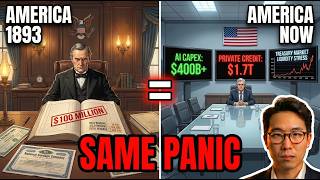
On April 21st, 1893, Treasury Secretary John G. Carlisle watched the federal gold reserve fall below the $100 million line that markets had quietly decided was the boundary between a government that could honor its obligations and one that might not. Three weeks later, the National Cordage Company — the hottest speculative stock in America, built on consolidation debt rather than rope profits — collapsed in a single trading session. Within five months, 500 banks failed and 15,000 businesses went under. The Panic of 1893 became the worst depression in American history until 1929, built from three threads: railroad overbuilding financed by debt nobody could service, one speculative stock that became the trigger everyone remembers, and a government monetary policy trying to honor two incompatible commitments at once.
America in 2025 is reassembling the same three-part structure at a scale the 1880s railroad bond market never approached. AI infrastructure spending is projected above $400 billion for 2025 alone, financed heavily through debt and off-balance-sheet structures, on an assumption of future demand nobody can currently verify. Private credit — a $1.7 trillion sector embedded inside retirement accounts most savers never examine — has grown explosively by lending to exactly the kind of leveraged borrowers 1893's railroads represented. And the Federal Reserve is attempting to simultaneously protect dollar credibility and support a Treasury market financing $2 trillion annual deficits, the modern version of the Sherman Silver Purchase Act's incompatible promise. In 1893, J.P. Morgan personally rescued the Treasury's gold reserves. There is no private actor today with a balance sheet anywhere close to that scale.
What You'll Learn:
▸ Why the Panic of 1893 actually started with railroad debt, not silver policy — and why silver was only the visible trigger
▸ How the National Cordage Company became the most important stock in America for one week, and why its collapse exposed a much larger problem
▸ What the Sherman Silver Purchase Act actually required — and why honoring two monetary commitments simultaneously made the gold reserve crisis structurally inevitable
▸ How AI infrastructure spending in 2025 replicates the railroad overbuilding pattern of the 1880s, dollar for dollar in structural logic
▸ Why the $1.7 trillion private credit market is the modern railroad bond market, hidden inside ordinary retirement accounts
▸ What J.P. Morgan's 1895 gold rescue actually required — and why no private institution today could replicate it at modern scale
▸ Why "the $100 trillion liquidation has begun" describes a process already running across multiple markets, not a single future event
The Timeline:
1880-1890 — American railroad mileage roughly doubles; financed overwhelmingly through bond debt
1890 — Sherman Silver Purchase Act passed; Treasury obligated to buy silver, drain gold via redemption
February 1893 — Philadelphia and Reading Railroad fails; Erie Railroad follows shortly after
April 21, 1893 — Treasury gold reserve falls below the $100 million psychological threshold
May 5, 1893 — National Cordage Company collapses into receivership in a single trading session
1893-1894 — 500 banks fail; 15,000 businesses collapse; unemployment reaches historic highs
1895 — J.P. Morgan organizes private syndicate to personally rescue Treasury gold reserves
2020-2024 — Private credit market expands explosively past $1.7 trillion, deeply embedded in pension and insurance portfolios
2024-2025 — AI infrastructure capital expenditure surpasses $400 billion annually across hyperscalers
2024 — Federal Reserve manages incompatible mandate: dollar credibility versus Treasury market support for $2T deficits
2025 — Treasury market liquidity stress indicators and AI valuation concentration both reach historic extremes
Carlisle inherited arithmetic he didn't create. The arithmetic did what arithmetic always eventually does.
Subscribe to see the structure beneath the headlines before it becomes consensus.
America in 2025 is reassembling the same three-part structure at a scale the 1880s railroad bond market never approached. AI infrastructure spending is projected above $400 billion for 2025 alone, financed heavily through debt and off-balance-sheet structures, on an assumption of future demand nobody can currently verify. Private credit — a $1.7 trillion sector embedded inside retirement accounts most savers never examine — has grown explosively by lending to exactly the kind of leveraged borrowers 1893's railroads represented. And the Federal Reserve is attempting to simultaneously protect dollar credibility and support a Treasury market financing $2 trillion annual deficits, the modern version of the Sherman Silver Purchase Act's incompatible promise. In 1893, J.P. Morgan personally rescued the Treasury's gold reserves. There is no private actor today with a balance sheet anywhere close to that scale.
What You'll Learn:
▸ Why the Panic of 1893 actually started with railroad debt, not silver policy — and why silver was only the visible trigger
▸ How the National Cordage Company became the most important stock in America for one week, and why its collapse exposed a much larger problem
▸ What the Sherman Silver Purchase Act actually required — and why honoring two monetary commitments simultaneously made the gold reserve crisis structurally inevitable
▸ How AI infrastructure spending in 2025 replicates the railroad overbuilding pattern of the 1880s, dollar for dollar in structural logic
▸ Why the $1.7 trillion private credit market is the modern railroad bond market, hidden inside ordinary retirement accounts
▸ What J.P. Morgan's 1895 gold rescue actually required — and why no private institution today could replicate it at modern scale
▸ Why "the $100 trillion liquidation has begun" describes a process already running across multiple markets, not a single future event
The Timeline:
1880-1890 — American railroad mileage roughly doubles; financed overwhelmingly through bond debt
1890 — Sherman Silver Purchase Act passed; Treasury obligated to buy silver, drain gold via redemption
February 1893 — Philadelphia and Reading Railroad fails; Erie Railroad follows shortly after
April 21, 1893 — Treasury gold reserve falls below the $100 million psychological threshold
May 5, 1893 — National Cordage Company collapses into receivership in a single trading session
1893-1894 — 500 banks fail; 15,000 businesses collapse; unemployment reaches historic highs
1895 — J.P. Morgan organizes private syndicate to personally rescue Treasury gold reserves
2020-2024 — Private credit market expands explosively past $1.7 trillion, deeply embedded in pension and insurance portfolios
2024-2025 — AI infrastructure capital expenditure surpasses $400 billion annually across hyperscalers
2024 — Federal Reserve manages incompatible mandate: dollar credibility versus Treasury market support for $2T deficits
2025 — Treasury market liquidity stress indicators and AI valuation concentration both reach historic extremes
Carlisle inherited arithmetic he didn't create. The arithmetic did what arithmetic always eventually does.
Subscribe to see the structure beneath the headlines before it becomes consensus.














![[おかしい]都構想の住民投票を大阪府民に投票させようとする維新 #足立康史 #維新 #白岩正三 #国民民主党 #足立康史の政策政局徹底解説ch](https://img.youtube.com/vi/cXozitsMaE8/mqdefault.jpg)