Hidden in Plain Sight: The Pattern Shared By Every Highly Sensitive Person
リアクション
2026年07月18日
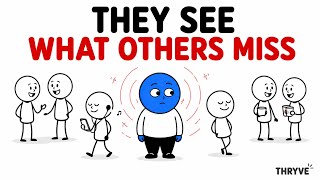
Do you find yourself noticing things that others completely miss? A sudden shift in someone's tone, the heavy texture of a room when tension is high, or feeling completely drained after a long day in a high-stimulation environment? You’ve probably been told you're "too sensitive" or advised to "toughen up." But science reveals that this sensitivity isn't a choice, a weakness, or a psychological flaw—it is a distinct, documented biological trait.
In this video, we explore the deep neuroscience and evolutionary psychology behind Sensory Processing Sensitivity, more commonly known as the trait of the Highly Sensitive Person (HSP). Pioneered by psychologist Dr. Elaine Aron in 1991, research shows that roughly 15 to 20 percent of the population possesses a nervous system designed to process the world at a much deeper level.
Rather than registering more raw input, the highly sensitive brain simply does more with the information it receives. We break down the exact brain regions involved and how this trait offers profound evolutionary advantages.
We examine the clinical data and psychological frameworks, including:
The D.O.E.S. Framework: Dr. Aron’s core components of the HSP trait—Depth of processing, Overstimulation, Emotional reactivity/empathy, and Sensitivity to subtleties.
The Neurological Blueprint: How fMRI imaging proves that HSPs show heightened activation in the mirror neuron system, the insula, and sensory integration centers.
The 100+ Species Pattern: Why evolutionary biologist David Sloan Wilson discovered that 20% of many animal populations act as the group's "early warning system."
Differential Susceptibility: Dr. Jay Belsky’s framework showing why HSPs are biologically wired to be hyper-responsive to both highly supportive and highly adverse environments.
The Orchid vs. Dandelion Hypothesis: Dr. W. Thomas Boyce’s breakthrough child development theory regarding how environmental conditions dramatically shape sensitive nervous systems.
This video is an objective, research-driven look at cognitive differences, human biology, and environmental optimization. Understanding this trait will fundamentally change how you view your boundaries, your relationships, and your place in a high-pace world.
If you value deep, analytical breakdowns of cognitive science and human psychology, make sure to Subscribe to the channel!
📌 Chapters (Timestamps)
0:00 - The Reality of Being Highly Sensitive
1:32 - Dr. Elaine Aron and the D.O.E.S. Framework
3:10 - The Neuroscience of the Highly Sensitive Brain
4:45 - The 100+ Species: Evolution's Early Warning System
6:20 - Differential Susceptibility: More Responsive, Not More Fragile
7:55 - The Cultural Mismatch: Why Modern Systems Fail HSPs
9:15 - The Comparison Problem & The Myth of Weakness
10:40 - The Orchid and the Dandelion Childhood Hypothesis
12:12 - Environmental Control: Moving from Exhaustion to Optimization
13:35 - The Cost of Meaningless Work for the Deep Brain
14:50 - Conclusion: Shifting Your Relationship to the Trait
#Neuroscience #HighlySensitivePerson #HSP #SensoryProcessingSensitivity #CognitivePsychology #EvolutionaryBiology #OrchidChild #BrainScience
In this video, we explore the deep neuroscience and evolutionary psychology behind Sensory Processing Sensitivity, more commonly known as the trait of the Highly Sensitive Person (HSP). Pioneered by psychologist Dr. Elaine Aron in 1991, research shows that roughly 15 to 20 percent of the population possesses a nervous system designed to process the world at a much deeper level.
Rather than registering more raw input, the highly sensitive brain simply does more with the information it receives. We break down the exact brain regions involved and how this trait offers profound evolutionary advantages.
We examine the clinical data and psychological frameworks, including:
The D.O.E.S. Framework: Dr. Aron’s core components of the HSP trait—Depth of processing, Overstimulation, Emotional reactivity/empathy, and Sensitivity to subtleties.
The Neurological Blueprint: How fMRI imaging proves that HSPs show heightened activation in the mirror neuron system, the insula, and sensory integration centers.
The 100+ Species Pattern: Why evolutionary biologist David Sloan Wilson discovered that 20% of many animal populations act as the group's "early warning system."
Differential Susceptibility: Dr. Jay Belsky’s framework showing why HSPs are biologically wired to be hyper-responsive to both highly supportive and highly adverse environments.
The Orchid vs. Dandelion Hypothesis: Dr. W. Thomas Boyce’s breakthrough child development theory regarding how environmental conditions dramatically shape sensitive nervous systems.
This video is an objective, research-driven look at cognitive differences, human biology, and environmental optimization. Understanding this trait will fundamentally change how you view your boundaries, your relationships, and your place in a high-pace world.
If you value deep, analytical breakdowns of cognitive science and human psychology, make sure to Subscribe to the channel!
📌 Chapters (Timestamps)
0:00 - The Reality of Being Highly Sensitive
1:32 - Dr. Elaine Aron and the D.O.E.S. Framework
3:10 - The Neuroscience of the Highly Sensitive Brain
4:45 - The 100+ Species: Evolution's Early Warning System
6:20 - Differential Susceptibility: More Responsive, Not More Fragile
7:55 - The Cultural Mismatch: Why Modern Systems Fail HSPs
9:15 - The Comparison Problem & The Myth of Weakness
10:40 - The Orchid and the Dandelion Childhood Hypothesis
12:12 - Environmental Control: Moving from Exhaustion to Optimization
13:35 - The Cost of Meaningless Work for the Deep Brain
14:50 - Conclusion: Shifting Your Relationship to the Trait
#Neuroscience #HighlySensitivePerson #HSP #SensoryProcessingSensitivity #CognitivePsychology #EvolutionaryBiology #OrchidChild #BrainScience